
The right EDI vendor matters more than you think. Businesses rely on the smooth flow of data to keep their operations running efficiently. In manufacturing, retail, logistics, and healthcare, electronic data interchange (EDI) is the backbone of that exchange — automating communication between trading partners and ensuring accuracy at every step. Yet while EDI is the enabling technology, it’s your EDI vendor that determines how well it performs. A strong vendor can streamline operations, enhance accuracy, and future-proof your systems. A poor one can slow your supply chain, introduce errors, and damage partner relationships.
The truth is, your EDI infrastructure is only as strong as the vendor behind it. The right EDI provider ensures seamless integration, strong customer support, and reliable EDI transactions that meet compliance requirements while driving business growth. In this guide, we’ll break down what to look for in an EDI vendor, explore different EDI solutions, and explain how the right partner can make the difference between stagnation and success.
Table of Contents
- What and EDI Vendor Really Does
- The EDI Vendor Landscape
- Why Vendor Choice Matters
- The Role of Integration and System Connectivity
- Core Capabilities Every EDI Vendor Should Offer
- The Power of Advanced EDI Solution
- Why Customer Support Defines the Vendor Relationship
- Real-World Impact: The Vendor Difference in Action
- Questions to Ask Before You Choose
- Security and Compliance: Protecting Your Data
- Common Mistakes When Choosing a Vendor
- Future Trends in EDI Integration
- The Business Impact of Choosing the Right Vendor
What an EDI Vendor Really Does: From Transactions to Integration
An EDI vendor delivers the software, services, and expertise required to manage automated document exchange between systems. Their job is to help businesses exchange EDI documents — such as purchase orders, invoices, and shipment confirmations — without manual input or paper. Beyond technology, your vendor handles integration between your internal systems (like your ERP system or WMS) and those of your trading partners. The result is a connected ecosystem where data flows effortlessly, improving accuracy, compliance, and speed.
A quality vendor also offers ongoing EDI service, managing communications, file translation, validation, and partner compliance. They ensure your EDI transactions are secure and formatted correctly according to standards such as EDIFACT or ANSI X12. Their customer support team becomes your frontline defense against disruptions, ensuring you never miss a critical exchange.
The EDI Vendor Landscape
The EDI space is vast, populated by providers ranging from traditional EDI service bureaus to modern cloud EDI vendors offering AI-driven dashboards and analytics. Understanding the differences among these providers is essential. Traditional vendors often specialize in on-premise EDI software that gives you complete control but requires extensive IT resources. Cloud-based vendors, on the other hand, offer scalable, subscription-based visibility to EDI platforms that are updated automatically and accessible from anywhere.
Some providers offer outsourced solutions, managing your entire EDI infrastructure while you maintain visibility through online portals. Others provide hybrid EDI solutions, allowing companies to balance internal control with vendor-managed support. Each model has strengths; the right one depends on your enterprise size, data sensitivity, and integration complexity.
Why Vendor Choice Matters
Choosing the right EDI vendor has far-reaching implications. Your provider impacts every aspect of your supply chain — from order accuracy and partner satisfaction to inventory control and cash flow. When your EDI integration runs smoothly, it reduces manual tasks, speeds up processing, and enhances collaboration with customers and suppliers. A reliable EDI service provider ensures consistency across thousands of transactions, keeping your business compliant and competitive.
The wrong vendor, however, can create bottlenecks. Downtime, delayed transactions, or poor customer support can result in missed orders, partner disputes, or financial penalties. The cost of inefficiency often outweighs any savings from a cheaper, less capable provider.
The Role of Integration and Supply Chain Connectivity
Integration is at the heart of any successful EDI implementation. Your vendor’s ability to connect EDI workflows to your ERP system, accounting tools, and logistics applications determines how effectively data moves through your organization. A well-integrated EDI solution eliminates rekeying errors and accelerates fulfillment. For example, when a customer sends a purchase order, it should automatically populate your ERP, trigger warehouse picking, and update the shipment record without any manual steps. This level of seamless integration saves time and money while improving visibility across departments.
Modern EDI providers also support API-driven integration tools, allowing EDI to coexist with web services, JSON, and cloud-based applications. This combination of legacy stability and modern flexibility creates a hybrid architecture that can scale with your business.
Core Capabilities Every EDI Partner Should Offer
When evaluating EDI vendors, focus on these core capabilities:
- Integration Flexibility – Support for multiple connection methods, including APIs, AS2, and SFTP, ensures adaptability.
- Compliance Management – Automatic updates for standards like EDIFACT and ANSI X12 prevent costly rejections.
- Data Validation and Mapping – Vendors should provide automated error handling, so you don’t have to manually correct failed transactions.
- Scalability – As you add new trading partners, your vendor should scale quickly without heavy setup work.
- Robust Customer Support – 24/7 monitoring for mission-critical operations is non-negotiable.
These features distinguish the top EDI providers from the rest. They don’t just send files—they ensure each transaction is complete, compliant, and error-free.
Evaluating EDI Expertise
The best EDI vendors bring decades of industry-specific experience. They understand not only the technology but the business context — whether it’s retail order management, manufacturing scheduling, or healthcare compliance.
Ask your potential EDI provider about their experience with your trading partners or industry standards. For example, vendors supporting large retailers must be familiar with routing guides, chargeback rules, and delivery windows. A vendor with EDI expertise in your sector saves you time and avoids costly missteps. Look for proof through certifications, references, and client success stories. An experienced vendor won’t just implement your system; they’ll improve it.
Comparing the Top EDI Providers
With so many EDI providers on the market, comparison requires careful consideration of both features and support. The top EDI solutions offer flexible deployment models, transparent pricing, and strong service guarantees.
Evaluate each vendor based on integration capability, global reach, uptime, and the ability to handle multiple types of EDI documents. Leading EDI service providers also offer real-time monitoring, so you can track every transaction from submission to confirmation. The best vendors go beyond basic delivery—they partner with your team to continuously improve workflows, ensuring your EDI remains an engine for growth.
The Power of Advanced EDI Solutions
The latest generation of advanced EDI solutions has transformed how businesses handle data. These systems integrate artificial intelligence and analytics to automate exception handling and provide real-time visibility into performance.
For example, modern EDI platforms include dashboards that display all current transactions, flag potential delays, and allow your team to act before a problem escalates. Predictive analytics can anticipate partner issues based on transaction trends. By leveraging automation, advanced EDI solutions shift EDI from a reactive back-office function to a proactive business enabler. The result is improved decision-making, reduced manual intervention, and a more resilient supply chain.
Cloud EDI Systems: The New Normal
Cloud EDI systems have become the industry standard. They provide fast deployment, real-time scalability, and lower total cost of ownership compared to legacy systems.
By moving EDI to the cloud, companies eliminate server maintenance, backups, and manual updates. Vendors handle upgrades and compliance changes automatically, reducing IT workloads. For distributed enterprises, cloud EDI offers global access to the same data exchange environment, ensuring consistency across regions. Whether your business processes hundreds or millions of EDI transactions, via an EDI VAN or APIs, a cloud-based architecture ensures stability and speed.
The Role of EDI Service Bureaus
EDI service bureaus offer a fully managed EDI service model. They oversee setup, monitoring, and ongoing operations, often serving as the middle layer between your internal systems and trading partners.
For companies with limited IT staff, this outsourced solution can be transformative. It provides enterprise-level reliability without requiring in-house specialists. The bureau handles integration, mapping, and compliance, while your team retains full visibility into each transaction through online dashboards. This model allows you to benefit from expert management while maintaining strategic control—a balance many businesses find ideal.
Why Customer Support Defines the Vendor Relationship
No matter how advanced your system, issues can arise. How your vendor handles those moments defines their true value. Exceptional customer support includes rapid response times, technical expertise, and proactive communication. The best vendors don’t wait for you to call—they monitor systems, detect anomalies, and resolve problems before they impact your operations.
Think of customer support as an extension of your own organization. In a connected supply chain, every minute of downtime matters, and the right EDI service provider keeps you up and running.
Real-World Impact: The Vendor Difference in Action
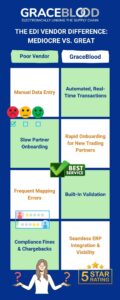
Let’s consider two mid-sized distributors. Both process thousands of EDI transactions daily. Company A chose a basic EDI vendor with limited integration tools and slow response times. Delays in transmission caused missed shipments, leading to chargebacks and strained customer relationships.
Company B partnered with a top EDI provider offering cloud EDI capabilities, predictive analytics, and around-the-clock monitoring. Their automation eliminated rekeying errors, improved fulfillment speed, and boosted partner satisfaction. The difference wasn’t in what EDI did — both exchanged data — but in how well their vendors executed. The vendor choice directly influenced operational efficiency and revenue outcomes.
Questions to Ask Before You Choose
Before selecting your EDI vendor, ask:
- Can your EDI platform integrate with our backend system and accounting software?
- How fast can you onboard new trading partners?
- Do you support multiple document types like 810 (invoices) and 850 (purchase orders)?
- What kind of encryption do you use for data exchange?
- How often do you update mappings for compliance with EDIFACT or ANSI X12?
- What’s your average response time for customer support?
The right answers signal a partner capable of supporting your enterprise long-term.
Security and Compliance: Protecting Your Data
Security should never be an afterthought. A trusted EDI vendor safeguards sensitive information through encryption, authentication, and secure network protocols. Leading EDI service providers comply with SOC 2 standards, offering confidence that your data meets regulatory and partner requirements. Vendors should also maintain detailed audit logs, allowing you to trace every transaction for accuracy and accountability.
Compliance failures are costly. That’s why your EDI vendor’s expertise in data protection and regulatory frameworks is just as important as their technology stack.
Common Mistakes When Choosing a Vendor
Businesses often make three key mistakes when choosing an EDI provider. The first is prioritizing price over performance—low-cost solutions may lead to high downtime or poor integration. The second is underestimating the need for customer support, assuming automation alone will prevent issues. The third is overlooking scalability—some vendors can’t handle growth or additional partners without major reconfiguration.
Avoid these pitfalls by selecting a provider with proven reliability, future-ready EDI solutions, and an adaptable EDI platform that grows with your organization.
Future Trends in EDI Integration
The future of EDI is dynamic and intelligent. Advanced EDI solutions now blend with APIs, allowing real-time communication and data synchronization. Artificial intelligence enhances automation by predicting delays, correcting mapping errors, and optimizing workflows.
In the next few years, expect vendors to offer integration capabilities that connect EDI with IoT, analytics, and blockchain systems, enabling end-to-end visibility. The EDI space is evolving from a document exchange framework to a connected digital ecosystem. Forward-thinking EDI providers will continue to bridge traditional systems with modern digital transformation strategies—offering both stability and innovation.
The Business Impact of Choosing the Right EDI Provider
Ultimately, your EDI vendor determines how well your business runs. A reliable provider accelerates processes, strengthens partner relationships, and reduces operating costs. They empower your team to focus on strategy instead of troubleshooting.
When integration works flawlessly, EDI files move like electricity through your organization—silent, fast, and dependable. The right EDI provider transforms compliance into collaboration, paperwork into partnership, and data into insight. Your choice of vendor isn’t just about technology—it’s about shaping your company’s agility, reputation, and profitability.
Your EDI Vendor Defines More Than Your Data Flow
An EDI vendor isn’t just a service supplier; they’re a strategic partner shaping how your enterprise communicates, collaborates, and grows. From ERP integration and data exchange to automation and compliance, they influence every part of your digital ecosystem. A dependable EDI service provider ensures your transactions are accurate, secure, and timely—building trust across your supply chain. The right vendor reduces costs, improves customer experiences, and gives your organization the agility it needs to compete.
GraceBlood’s Standard of Excellence: The Difference Between Service and Partnership
So, what difference does your EDI vendor make in your business? In a connected world, the answer is simple: all the difference. Choose wisely, and your EDI solution becomes not just a system, but a catalyst for continuous improvement and long-term business growth.
Ready to experience the difference a true EDI partner can make?
GraceBlood delivers seamless integration, unmatched expertise, and a support team that treats your success as our own.
👉 Contact us today to start your journey toward smarter, more connected business operations.