

Will AI replace EDI? It’s a question many organizations are asking as artificial intelligence continues to reshape nearly every aspect of business. From chatbots and predictive analytics to autonomous agents and advanced automation, AI is transforming how companies operate. It’s understandable why some wonder whether Electronic Data Interchange (EDI) is next.
The short answer is no.
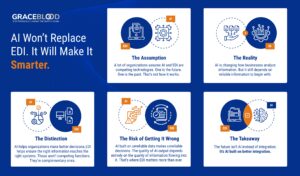
AI isn’t replacing EDI for the same reason Excel didn’t replace accounting. One is a tool for intelligence, while the other is the trusted framework businesses rely on to exchange critical information. EDI enables businesses to exchange structured transactions reliably between trading partners. AI, on the other hand, excels at analyzing information, recognizing patterns, making predictions, and helping people make better decisions. That distinction is especially important because EDI remains the foundation of global B2B commerce. Industry analysts estimate that more than 80% of B2B transactions are still exchanged using EDI, demonstrating that standardized electronic document exchange remains critical even as AI adoption accelerates.
Rather than competing, AI and EDI are becoming increasingly complementary. AI can make EDI operations more efficient by improving visibility, identifying exceptions before they become problems, reducing manual intervention, and providing actionable insights from EDI transactions. The result isn’t the end of EDI—it’s the beginning of smarter, more intelligent EDI operations.
In this article, we’ll explore why AI won’t replace EDI, where AI delivers real value within modern EDI, and what the future of EDI looks like as these technologies continue evolving together.
Table of Contents
- AI Tools and EDI Solutions Solve Different Problems
- Why Supply Chain Data Still Requires Structured EDI Standards
- AI Improves EDI Without Replacing It
- How AI Tools Enhance EDI Operations
- EDI Mapping, Automation, and AI Agents
- Providers are Combining Technology With Human Expertise
- AI Models Improve Analytics Across EDI Environments
- The Foundation of EDI Isn’t Changing
- The Future of AI and EDI
- Retail EDI is a Great Example of AI’s Value
- Businesses Still Need Trusted Trading Partner Networks
AI Tools and EDI Solutions Solve Different Problems
One of the biggest misconceptions surrounding AI is that it can simply replace every existing business technology. In reality, successful organizations understand that different technologies solve different problems.
EDI software exists for one primary purpose: exchanging standardized business documents between organizations. Purchase orders, invoices, Advance Ship Notices (ASNs), inventory updates, payment documents, and hundreds of other transaction types all move through established EDI standards that ensure every system interprets information consistently.
These standards have been refined over decades because reliability matters. That reliability is reflected in the scale of EDI itself. Billions of EDI transactions are exchanged every year across industries including retail, manufacturing, healthcare, transportation, and distribution, making it one of the most widely used B2B technologies in the world.
AI, meanwhile, doesn’t replace those standards. AI can occasionally generate incorrect information with complete confidence. EDI standards, by contrast, are deterministic. Every field has a meaning, every transaction follows a documented specification, and every trading partner expects consistent execution. This predictability is precisely why EDI remains foundational to mission-critical supply chains.
Instead, AI tools interpret information, identify patterns, answer questions, summarize trends, generate recommendations, and automate decision-making.
Think of it this way:
| EDI | AI |
|---|---|
| Moves business documents | Interprets business information |
| Follows established standards | Learns from historical patterns |
| Ensures transaction accuracy | Provides recommendations |
| Connects business systems | Assists people making decisions |
| Executes processes | Improves processes |
Both technologies are valuable—but they serve entirely different (yet complementary) roles.
Why Supply Chain Data Still Requires Structured EDI Standards
Modern supply chain operations depend on consistency.
Every retailer, supplier, logistics provider, warehouse, and ERP system expects information to arrive in a predictable format. Purchase orders must contain the correct fields. Product identifiers must follow agreed-upon standards. Shipment notices need specific information before goods arrive.
Without standardized data, automation quickly breaks down. This is exactly why EDI standards continue to exist despite rapid advances in AI. Imagine an AI generating invoices in a different format every time based on what it believes looks best. Human readers might understand them, but computer systems would struggle to process the information automatically.
Business integrations require structure—not creativity. That’s why AI enhances EDI rather than replacing it. AI can review transactions for anomalies, identify missing information, or suggest corrections before transmission. But once the transaction is ready, it still travels through the same trusted EDI framework that trading partners expect.
AI Improves EDI Without Replacing It
The greatest value AI brings to EDI isn’t document creation. It’s operational intelligence.
Traditional EDI systems often notify users only after a problem occurs:
- A shipment failed.
- An invoice was rejected.
- A purchase order contained invalid data.
- A trading partner changed a requirement.
AI can dramatically improve this process by identifying risks much earlier.
AI can recognize exception patterns
Instead of reviewing thousands of transactions manually, AI models can detect:
- Frequent customer errors
- Repeating validation failures
- Missing required fields
- Duplicate orders
- Pricing inconsistencies
- Unexpected demand spikes
Rather than simply reporting failures, AI explains why they’re occurring.
AI can prioritize exceptions
Not every error deserves immediate attention. AI helps organizations focus on issues that actually affect customers, compliance, or revenue while deprioritizing routine exceptions. This allows EDI teams to spend less time reviewing dashboards and more time resolving meaningful problems.
AI can recommend next actions
Rather than requiring employees to search through previous support tickets or documentation, AI can quickly identify likely causes of an issue, recommend potential resolutions, surface similar cases that were successfully resolved in the past, and suggest the appropriate escalation path when necessary. By providing relevant context and actionable recommendations, AI dramatically reduces investigation time and helps support teams resolve EDI exceptions more efficiently.
How AI Tools Enhance EDI Operations
AI becomes especially valuable after transactions have already been exchanged.
Examples include:
Smarter exception management
Instead of waiting for customer complaints to reveal problems, AI continuously monitors EDI workflows for unusual behavior and emerging exceptions. It can detect anomalies such as unexpected transaction volumes, delayed acknowledgements, missing Advance Ship Notices (ASNs), rejected invoices, or failed document routing. By identifying these issues in real time, AI enables organizations to address potential problems proactively—often before customers or trading partners are even aware that something has gone wrong.
Better customer service
Customer service representatives frequently receive questions like:
- Where’s my order?
- Has it shipped?
- Why wasn’t this invoice received?
Rather than searching multiple systems, AI can retrieve relevant transaction history almost instantly using integrated EDI data.
Faster onboarding
AI can help accelerate documentation review, identify mapping inconsistencies, summarize retailer implementation guides, and assist developers with repetitive configuration tasks. However, experienced consultants still validate every implementation because every trading partner has unique business rules.
EDI Mapping, Automation, and AI Agents
Perhaps the biggest misconception involves EDI mapping. Many assume AI can simply create mappings automatically. While AI can certainly assist developers, successful mappings require significantly more than matching fields. Two customers using the exact same ERP often implement the same EDI document for the same trading partner in completely different ways.
An experienced implementation team like GraceBlood considers far more than simply matching data fields. Successful EDI mapping requires a deep understanding of business rules, customer-specific requirements, ERP behavior, conditional logic, exception handling, compliance testing, and document sequencing. These decisions depend on industry knowledge, implementation experience, and an understanding of how business processes operate in the real world—expertise that goes well beyond pattern recognition alone.
That said, AI agents can dramatically improve productivity by:
- generating mapping documentation
- identifying repetitive logic
- suggesting transformation rules
- validating documentation
- accelerating testing
- reviewing implementation notes
Rather than replacing implementation specialists, AI helps them complete projects faster.
Providers are Combining Technology With Human Expertise
One reason organizations choose a managed EDI provider is because EDI is rarely a “set it and forget it” technology. EDI environments are constantly changing. Retailers revise routing guides, manufacturers introduce new products, ERP systems receive upgrades, and government regulations continue to evolve.
An experienced managed service team monitors these developments continuously. AI can help identify changing trends faster, but knowledgeable providers still determine how those changes should be implemented.
The strongest EDI solutions increasingly combine experienced consultants, intelligent monitoring, workflow automation, predictive analytics, AI-assisted support, and proactive customer communication. Together, these capabilities help organizations respond more quickly to change while maintaining the reliability and expertise that EDI requires.
The human expertise remains essential. That expertise is becoming even more important as the market grows. Analysts project the global EDI market will nearly double from approximately $34 billion in 2024 to more than $67 billion by 2030, reflecting continued investment in EDI alongside newer technologies like AI.
AI Models Improve Analytics Across EDI Environments
Historically, organizations relied on reports showing what had already happened. Today’s AI-powered analytics go much further.
AI models analyze historical EDI data to identify:
- seasonal purchasing trends
- recurring compliance issues
- inventory shortages
- supplier performance
- transportation delays
- customer ordering behavior
Instead of reacting to yesterday’s problems, businesses can prepare for tomorrow’s opportunities. For example, an AI model might identify that one retailer consistently increases orders by 35% during busy seasons. Operations teams can prepare inventory before demand spikes. Another model may discover that invoice disputes increase whenever a specific product family ships from one warehouse.
Rather than manually reviewing thousands of transactions, AI highlights the trend automatically.
The Foundation of EDI Isn’t Changing
Some people describe AI as replacing traditional EDI. In reality, the opposite is happening. Organizations are modernizing how they manage EDI—not replacing EDI itself.
Today’s modern EDI environments often include:
- cloud-based integration platforms
- real-time dashboards
- automated alerts
- API connectivity
- AI-assisted monitoring
- advanced reporting
- workflow automation
Yet underneath these improvements, standardized EDI transactions remain unchanged. The X12 850 purchase order still performs the same essential function. The ASN still confirms shipments. And the invoice still requests payment.
AI enhances visibility around these transactions rather than replacing the transactions themselves.
The Future of AI and EDI
AI Technology Makes EDI Automation More Intelligent
Many organizations already benefit from EDI automation. Purchase orders automatically enter ERP systems and invoices generate automatically. Shipping notices transmit electronically and acknowledgements confirm successful receipt. AI makes this automation smarter.
Instead of simply executing predefined workflows, AI can:
- identify unusual transaction timing
- predict likely failures
- recommend workflow improvements
- forecast processing delays
- detect suspicious activity
The automation doesn’t change. The decision-making surrounding the automation becomes more intelligent.
The Future of EDI Integration Services
The future isn’t AI versus EDI, it’s AI-enhanced EDI integration.
Organizations increasingly expect:
Faster implementations
AI helps implementation teams analyze specifications, summarize documentation, and accelerate project planning.
Better monitoring
Continuous intelligence identifies exceptions long before customers notice problems.
Improved compliance
AI can compare transactions against customer requirements and identify potential issues before documents are transmitted.
Better visibility
Executives gain dashboards that explain what is happening—not just lists of transactions.
More proactive support
Rather than waiting for support tickets, managed service teams can proactively contact customers about emerging issues.
This represents the next generation of integration services.
The Future of EDI Is Smarter, Not Smaller
As AI continues evolving, we’ll undoubtedly see new capabilities emerge.
Future platforms may include:
- conversational dashboards
- automated root cause analysis
- predictive fulfillment recommendations
- intelligent workflow optimization
- self-learning exception management
- natural language reporting
But none of these eliminate EDI. Instead, they make EDI significantly more valuable. Organizations will continue exchanging standardized transactions because standardized business communication remains essential. AI simply helps people understand those transactions faster.
Retail EDI Is a Great Example of AI’s Value
Few industries demonstrate this better than retail EDI.
Retailers often maintain hundreds of unique compliance requirements covering:
- labeling
- routing guides
- shipment timing
- carton contents
- ASN accuracy
- invoice validation
Missing just one requirement can result in chargebacks.
AI can continuously monitor transaction patterns to identify recurring retailer compliance issues, increasing rejection rates, unusual shipment timing, missing documents, and customer-specific trends that might otherwise go unnoticed. By analyzing these patterns in real time, organizations can proactively address potential problems before they result in chargebacks, shipment delays, or customer dissatisfaction. Rather than replacing retailer compliance processes, AI strengthens them by providing earlier visibility and more actionable insights.
Businesses Still Need Trusted Trading Partner Networks
AI doesn’t eliminate the importance of trusted business relationships. Successful EDI depends upon a reliable trading partner network.
Every organization still needs:
- secure communications
- reliable document delivery
- standardized message formats
- verified identities
- tested integrations
- dependable infrastructure
Whether documents move through AS2, VAN connections, APIs, or hybrid architectures, reliability remains critical. AI enhances visibility across those networks—but the underlying infrastructure still matters.
EDI Is Here To Stay
Despite the excitement surrounding AI, EDI remains the backbone of digital B2B commerce. Businesses still need standardized document exchange, reliable integrations, secure communication, and consistent transaction processing between partners. AI cannot replace these fundamental requirements because its strength lies elsewhere. AI won’t replace EDI because intelligence doesn’t eliminate infrastructure; it enhances it. The organizations that thrive over the next decade won’t choose between AI and EDI. Instead, they’ll combine both to build smarter, faster, and more resilient digital supply chains.
By reducing manual work, improving efficiency, enhancing analytics, identifying patterns across EDI environments, and helping organizations respond proactively to changing conditions, AI adds a new layer of intelligence on top of proven EDI processes.
For companies, enterprises, and managed service providers, the opportunity isn’t choosing between AI and EDI. It’s combining both technologies to build faster, more resilient EDI systems that improve the customer experience, support growing demand, simplify inventory updates, strengthen EDI exchanges, and prepare organizations for the future of EDI.
The organizations that gain the greatest competitive advantage won’t replace EDI with AI. They’ll use AI to make their existing EDI investments work harder, respond faster, and deliver more value across every aspect of their business.
Ready to make your EDI smarter? Contact us today to learn how we can help you modernize your EDI operations.