
Growth is usually a good problem to have. More customers, more orders, new markets, acquisitions, and expanding relationships with major retailers can all signal that the business is moving in the right direction. But growth that looks good on a P&L can expose weaknesses in an EDI environment that worked perfectly well when the company was smaller.
An in-house EDI setup may comfortably support 20 trading partners and predictable transaction volumes. Then the company lands a major retailer, acquires another business, migrates its ERP, or doubles its transaction volume. Suddenly, onboarding takes longer, mappings multiply, exceptions pile up, and the employee who understands how everything works becomes increasingly critical.
That is where the difference between DIY and managed EDI becomes important. DIY, or in-house EDI, gives a company direct responsibility for its EDI infrastructure, map development, monitoring, maintenance, and expertise. Managed EDI shifts much of that responsibility to an experienced EDI provider.
Both approaches can work. The more important question for a growing organization on an EDI journey is which model can continue working as the business changes.
This guide compares DIY and managed EDI solutions based on scalability, maintenance, cost, partner onboarding, business continuity, and the ability to adapt to long-term growth.
Table of Contents
- What “Scalability” Actually Means for an EDI Solution
- The DIY EDI Integration Model: What It Takes to Build and Keep Running
- The Managed EDI Model: How the Right EDI Provider Builds in Scalability
- Comparing DIY vs. Managed EDI on Four Growth Scenarios
- What This Costs Over 3 to 5 Years, Not Just at Launch
- How to Decide: Questions to Ask Before You Commit to Either Path
- Ready to See Where Your EDI Setup Stands?
- Frequently Asked Questions About DIY vs. Managed EDI
What “Scalability” Actually Means for an EDI Solution
In EDI, scalability means more than processing a larger number of transactions. A scalable environment should allow a company to add new trading partners without re-architecting its entire integration environment. It should absorb seasonal or unexpected transaction spikes, accommodate new business units, and support additional document types without requiring a new custom project every time the business changes.
For example, a company exchanging EDI 850 purchase orders and EDI 810 invoices may eventually need to support the EDI 856 Advance Ship Notice, or ASN, as a retailer’s requirements evolve. Another customer may require a different EDI format, such as a version of ANSI X12, while an international partner operates using EDIFACT.
The underlying business systems may also become more complex. EDI data might need to flow between an ERP, WMS, TMS, or other applications. One business relationship may use a value-added network (VAN), while another requires SFTP, FTP, XML, or API integration. Scalable EDI solutions need to accommodate that complexity without turning every change into a major development project.
The real test often comes during a significant business event. An acquisition may add dozens of trading partners almost overnight. A large retailer may impose new transaction or compliance requirements. An enterprise resource planning (ERP) integration project may require existing maps and workflows to be redesigned around a new ERP platform such as NetSuite or Microsoft Dynamics 365.
When these events happen, companies discover whether their EDI environment was designed to scale or simply designed to meet yesterday’s requirements.
The DIY EDI Integration Model: What It Takes to Build and Keep Running
A DIY EDI strategy gives the organization control over its technology and processes, but that control comes with responsibility. Traditional on-premise EDI can require infrastructure, EDI software, licensing, security, monitoring tools, and employees with specialized knowledge. Even companies using more modern cloud-based EDI solutions internally still need people who understand mapping, EDI compliance, partner requirements, exception management, and integration architecture.
The initial EDI implementation is only the beginning. Every new trading partner can introduce different requirements and or EDI documents . Even when two retailers exchange the same X12 document, their implementation guides, required fields, business rules, testing processes, and compliance expectations may and probably will differ.
That means data mapping must be maintained as relationships change. EDI translation rules need to remain aligned with internal applications. Retailer specifications must be monitored, and errors need to be investigated quickly enough to prevent downstream disruption.
As partner count and EDI transaction volume increase, so does ongoing maintenance. This is one of the hidden challenges of DIY EDI solutions. The infrastructure does not simply run indefinitely after implementation. EDI standards evolve, retailers update requirements, internal applications change, and new trading relationships create additional mappings and workflows.
The People Problem (Beyond the Technology)
The bigger risk may not be technology at all. Many organizations have in-house expertise, but that expertise is concentrated in one or two employees. One person knows why a particular map was customized, how a retailer handles an unusual field, which workaround was created five years ago, and what to check when a transaction fails.
That employee becomes a single point of failure. If that person leaves, retires, takes extended leave, or simply becomes overwhelmed, the business can suddenly lose years of institutional knowledge.
Documentation helps, but documentation rarely captures every exception, workaround, and historical decision embedded in a mature EDI environment. For in-house teams managing direct EDI, growth therefore creates two scaling challenges simultaneously: the technology must scale, and the company’s pool of specialized knowledge and technical support must scale with it.
The Managed EDI Model: How the Right EDI Provider Builds In Scalability
A managed EDI service approaches the problem differently. Instead of requiring the client to maintain all of the technology and expertise internally, the provider assumes responsibility for defined portions of the EDI platform and lifecycle.
With fully managed EDI, that can include trading partner configuration, mapping, testing, monitoring, transaction processing, troubleshooting, and compliance updates. The advantage is not simply outsourcing work. It is the ability to use processes and resources that have already been built to support multiple environments and trading partners, allowing the client to realize the full benefits of EDI.
Reusable Experience Makes Partner Onboarding and Implementation Faster
An experienced EDI service provider does not necessarily start every connection from scratch. Standardized workflows, established testing procedures, existing knowledge of retailer requirements, and reusable mapping assets can make partner onboarding more repeatable. For example, GraceBlood follows a proven EDI implementation methodology coined GADGET.
The provider may already understand how a major retailer expects an 850, 856, or 810 to be structured. The client’s internal ERP fields or legacy system still need to be mapped correctly, but the external requirements are not completely unfamiliar. That can reduce the amount of custom discovery required for each new relationship.
The same principle applies to supplier onboarding. As an organization adds suppliers, customers, warehouses, or business units, standardized processes can prevent each connection from becoming its own standalone technology project.
Growth Doesn’t Have to Mean Rebuilding the EDI Team
With DIY EDI, increasing transaction volume can eventually require additional employees, infrastructure, or licensing. With outsourced EDI, much of that scaling responsibility moves to the provider.
A company adding 30 new trading partners does not necessarily need to hire additional internal EDI specialists. Specific needs like a holiday volume spike does not automatically require the company to expand infrastructure for a peak that may last only a few weeks. This is one of the central benefits of fully managed EDI: capacity and expertise can expand without requiring the client to replicate that growth internally.
Costs Become More Predictable
Managed services also change the cost structure. Rather than treating every new stage of growth as another capital or staffing decision, managed EDI solutions typically provide a more predictable service-based cost structure.
That does not mean every managed model costs the same regardless of usage. Pricing can still change based on partner count, transaction volume, complexity, support requirements, and service level. But the organization can evaluate those costs without separately maintaining the full infrastructure and staffing required by DIY EDI solutions.
Comparing DIY vs. Managed EDI on Four Growth Scenarios
The differences become clearer when both models are placed under the same real-world pressures.
|
Growth Scenario |
DIY / In-House EDI |
Managed EDI |
| Onboarding new trading partner |
Internal staff review requirements, build or modify mappings, test transactions, configure communications, and support go-live. Each unfamiliar partner can require additional research and development.
|
The provider manages much of the partner onboarding process using standardized procedures, existing partner knowledge, and reusable assets where available. |
| Sudden volume spike |
The company is responsible for ensuring infrastructure, licenses, monitoring, and staffing can support the additional load. Unexpected growth can expose capacity limitations.
|
The EDI provider is responsible for supporting the contracted environment and scaling resources according to the service model and applicable SLA. |
| ERP migration or upgrade | Internal teams must determine how existing mappings and workflows interact with the new ERP and coordinate the EDI portion of the migration. |
The provider can coordinate EDI integration requirements with the ERP migration team and help preserve trading partner connectivity while backend systems change.
|
| Losing the person who manages EDI |
Institutional knowledge may leave with the employee, creating a potential support and continuity gap while another employee is trained or a replacement is hired.
|
Responsibility is distributed across the provider’s team, reducing dependency on one internal employee and preserving operational knowledge. |
The important distinction is not that DIY EDI cannot handle these situations. It can. The question is what the company must add each time growth creates another layer of complexity.
If every major customer win requires more custom development, every volume increase requires more infrastructure, and every system change requires scarce internal specialists, the environment may technically be scalable while becoming progressively harder and more expensive to operate.
What This Costs Over 3 to 5 Years, Not Just at Launch
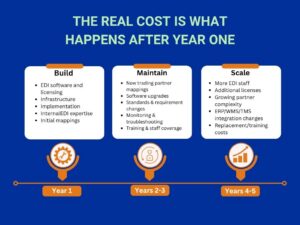
Cost comparisons between DIY and managed EDI can be misleading when they focus only on the EDI implementation process. An internal solution may initially appear less expensive because the company already has servers, IT staff, or existing software licenses. Likewise, web EDI, which often means manual data entry, can be an economical entry point for organizations with low transaction volumes and relatively simple requirements.
But the more useful comparison is the cost curve over three to five years. Imagine a company starts with 25 trading partners. Three years later, it has 75. Transaction volume has doubled, several customers require additional documents, the company has upgraded its ERP, and two internal employees now spend significant time maintaining EDI.
The relevant DIY cost is no longer simply the original software license. It includes employee compensation, recruiting and training, infrastructure, licensing, monitoring, security, mapping changes, testing, troubleshooting, upgrades, and the opportunity cost of IT resources being diverted from other initiatives.
Even relatively simple web EDI processes can become inefficient when employees are manually handling a growing number of transactions or relationships.
The economics of fully managed EDI work differently. Rather than building an internal organization capable of supporting every stage of growth, the business purchases access to an existing EDI vendor. That can make costs easier to forecast as the number of partners, documents, and transactions increases.
Where VelociLink™ Fits
GraceBlood’s VelociLink™ Managed EDI is structured around three service tiers: Essentials, Extended, and Enterprise.
Essentials can fit organizations that need the foundation of a managed environment without the complexity of a highly customized enterprise deployment.
Extended is designed for organizations requiring a broader level of service and support as their EDI environment becomes more involved.
Enterprise addresses more complex requirements where the organization may have a larger partner ecosystem, greater integration complexity, or more demanding operational needs.
The right tier depends on the environment rather than company size alone. A smaller company selling to demanding retailers may have more complex requirements than a much larger organization with a relatively simple trading model. This is why comparing EDI solutions solely on launch price can be misleading. The better financial question is: What will it cost us to operate this environment when the business is twice as complex as it is today?
How to Decide: Questions to Ask Before You Commit to Either Path
There is no universal rule that every company should abandon DIY EDI or that every organization requires fully managed EDI. Some businesses have experienced internal teams, well-documented environments, predictable growth, and sufficient resources to operate their own platforms effectively.
Others discover that EDI is consuming resources that would be more valuable elsewhere. Before committing to either model, VP-level operations, supply chain, finance, and technology leaders should ask several questions.
How many new trading partners do we realistically expect in the next three to five years?
Do not evaluate the EDI environment based only on today’s partner count.
Consider planned acquisitions, new sales channels, geographic expansion, large retail opportunities, and other growth initiatives. If the organization expects the number of trading partners to double, determine whether the current environment can support that growth without a major rebuild.
Do we genuinely have EDI expertise in-house?
There is an important difference between having an EDI team and having one employee who knows EDI. Identify who understands the architecture, EDI mappings, communications, retailer requirements, industry standards, exception processes, and integrations. Then ask what happens if that person is unavailable tomorrow.
If the answer is “we would have a serious problem,” the organization has a business continuity issue regardless of whether today’s EDI system is performing well.
What is our tolerance for chargebacks?
A failed transaction can have financial consequences.
Incorrect ASNs, late documents, missing information, and retailer compliance failures can generate chargebacks, delayed payments, or additional manual work. Companies evaluating EDI solutions should consider those operational costs alongside software and service fees.
The question is not whether errors can be eliminated entirely. They cannot. The question is how quickly errors are detected, who is responsible for investigating them, and whether the organization has the monitoring and expertise required to resolve them before they become larger problems.
Does our IT team actually have the bandwidth?
EDI may compete with cybersecurity, ERP projects, analytics, cloud migrations, CRM initiatives, infrastructure management, and dozens of other priorities.
Maintaining EDI internally can make sense when the organization deliberately wants that capability in-house and has the resources to support it. It becomes more difficult to justify when EDI maintenance continually pulls specialized IT employees away from higher-value projects.
What happens during the next ERP change?
Organizations rarely keep the same application environment forever. Whether the company moves to NetSuite, Dynamics 365, another ERP, or a new cloud architecture, EDI connections eventually need to adapt.
Evaluate whether the current model can support that transition without disrupting customers and suppliers. An outsourced EDI strategy can be particularly valuable when the organization wants the EDI layer to remain stable while internal applications change behind it.
What level of EDI provider support are we actually buying?
When comparing providers, look beyond feature lists. Determine who monitors transactions, who responds to errors, who communicates with trading partners, how escalation works, and what the SLA actually covers.
A platform that simply provides software is fundamentally different from a managed EDI service where people actively support the environment. Understanding that distinction is essential when comparing costs.
Read case studies and speak to references. The right EDI provider will be happy to share their success stories.
Ready to See Where Your EDI Setup Stands?
Growth exposes weaknesses in a DIY EDI setup long before those weaknesses necessarily appear on a P&L.
New trading partners begin taking longer to onboard. Mapping requests compete with other IT priorities. Transaction growth creates monitoring challenges. An ERP project suddenly touches dozens of existing integrations. And the departure of one knowledgeable employee can turn what looked like a stable environment into an operational risk.
That does not make DIY EDI inherently wrong. It means the EDI strategy that worked at one stage of the business may not be the right strategy for the next.
A managed model such as VelociLink™ is designed to absorb growth without requiring the client to continually re-staff, re-architect, and re-learn the complexities of electronic data interchange. The right choice ultimately depends on your growth trajectory, internal expertise, technology environment, trading partner requirements, and tolerance for operational risk.
Not sure which approach fits where your business is headed? Speak to one of our consultants to get started with the right EDI solution for your business today.
Frequently Asked Questions About DIY vs. Managed EDI
How do DIY EDI and managed EDI compare in terms of scalability and long-term maintenance?
DIY EDI requires a business to maintain its own onboarding processes, monitoring, mappings, infrastructure, and standards updates. As transaction volume and partner count grow, the organization may need additional staff, licenses, or infrastructure. Managed EDI shifts much of that responsibility to a provider with established processes and reusable assets. Over a three-to-five-year period, this can make scaling more predictable without requiring the client to expand its internal EDI operation at the same rate as the business.
What is fully managed EDI services?
Fully managed EDI is a model in which a third-party provider handles most or all of the EDI lifecycle on a company’s behalf, including trading partner mapping, onboarding, compliance monitoring, transaction processing, and troubleshooting. Instead of maintaining all EDI infrastructure and expertise internally, the business delegates those responsibilities to the provider. GraceBlood’s VelociLink™ offers managed services across Essentials, Extended, and Enterprise tiers so support can align with the complexity of the client’s environment.
What happens to an in-house EDI setup (EDI software) when the person managing it leaves?
When the employee managing an in-house environment leaves, the company may lose institutional knowledge about partner requirements, custom mappings, exceptions, and system-specific workarounds. That can create a service gap while another employee is trained or a replacement is hired. A managed model reduces this single-point-of-failure risk because operational knowledge and support responsibilities are distributed across a provider’s team.
Is managed EDI more expensive than DIY EDI over time?
Not necessarily. A meaningful comparison should include more than the initial software or implementation cost. DIY EDI can require hardware, software licensing, employee compensation, training, monitoring, upgrades, and additional resources as volume and partner count increase. Managed services generally use a more predictable service-based pricing model. GraceBlood’s VelociLink™, for example, offers no long-term contracts, no hidden fees, and no payments required until the client is live.
What are the warning signs that a DIY EDI setup won’t scale with the business?
Common warning signs include trading partner onboarding taking weeks rather than days, increasing dependence on one knowledgeable employee, growing transaction errors or chargebacks, and IT teams struggling to keep up with mapping and maintenance requests. Another warning sign is when an ERP migration, acquisition, volume increase, or new retailer requirement creates a scramble rather than a routine change. These symptoms suggest the EDI environment may no longer be scaling cleanly with the organization.
Heading to Microsoft Community Summit or SuiteWorld this month? So are we! Would love to meet you & hear about your company. Book a time here.