
Adopting a managed EDI solution is a significant operational decision with long-term implications for supply chain performance, trading partner relationships, system reliability, and data security. The right approach can reduce internal workload, improve transaction accuracy, and make it easier to support business growth. The wrong approach can introduce integration challenges, unexpected costs, and dependencies that are difficult to reverse.
Electronic data interchange has also evolved considerably from the on-premise systems many organizations traditionally used. Modern cloud-based EDI solutions can connect an ERP system with customers, suppliers, logistics providers, and other applications while supporting established EDI standards alongside technologies such as API and XML.
But moving EDI infrastructure and responsibilities to an outside EDI provider does not eliminate risk. It changes where those risks reside and how they need to be managed.
Executives evaluating EDI solution providers should look beyond basic functionality and pricing. Implementation methodology, ERP integration, security, scalability, provider flexibility, and ongoing support can have a major impact on the long-term success of the program.
Here are six of the most important risks to evaluate before choosing a managed EDI solution—and how organizations can mitigate them.
For ERP resellers: Understanding these risks can help you guide clients toward an EDI provider that complements the ERP project rather than creating new post-implementation problems that eventually come back to your team.
Table of Contents
- Implementation Risk: Underestimating Complexity and Timeline
- EDI Integration Risk: EDI That Doesn’t Connect to Your ERP
- Security and Compliance Risk: Data Breaches and Regulatory Exposure
- Vendor Lock-In Risk: Choosing an EDI Services Provider You Can’t Exit
- Scalability Risk: Providers That Can’t Grow With Your Supply Chain
- Support and Visibility Risk: No View Into Your EDI Documents
- Other EDI Delivery Models Executives Should Understand
- How GraceBlood Mitigates Managed EDI Risk
- Frequently Asked Questions About Managed EDI Solutions
Implementation Risk: Underestimating Complexity and Timeline
One of the first risks is assuming that EDI implementation is primarily a technical connection project.
Establishing connectivity is only part of the process. An implementation can involve partner onboarding, EDI mapping, ERP integration, data validation, testing, business-rule configuration, and compliance verification across multiple trading partners.
Different partners may use ANSI X12, EDIFACT, or other formats, while individual implementations of those EDI standards can vary significantly. What’s more, even within those established standards, we often still see a lot of variability. Even two customers using the same transaction set may require different fields, validation rules, identifiers, or business processes.
That complexity increases when data mapping must accommodate an organization’s internal applications or legacy systems. Rushing through these steps can create transaction failures that are difficult to identify until production begins. An incorrect mapping or business rule could result in rejected purchase orders, inaccurate invoices, failed advance ship notices, or chargebacks.
How to Mitigate the Risk
Ask every potential EDI provider to explain its implementation methodology in detail. There should be clearly defined milestones for requirements gathering, development, testing, validation, go-live, and post-launch optimization. Testing should include realistic transaction scenarios rather than simply confirming that a file can move between two systems.
GraceBlood uses its six-step GADGET™ methodology—Gather, Analyze, Develop, Go-live, Evaluate, and Tune—to provide structure throughout EDI implementation. Our methodology delivers implementations 50% faster than traditional approaches, and 91% of clients credit GADGET™ as fundamental to project success.
A structured process reduces implementation risk by making testing, business requirements, and trading partner readiness part of the project rather than treating them as last-minute considerations.
EDI Integration Risk: EDI That Doesn’t Connect to Your ERP
An EDI solution provides far less value if the information it exchanges cannot flow efficiently into the applications employees actually use. Solutions like web EDI portals are considered pseudo-EDI — they satisfy the compliance mandate but don’t deliver the real benefits of EDI integration.
On the other side, we sometimes see poorly integrated systems. Poor EDI integration can create data silos and manual workarounds between EDI and the ERP system. Employees may find themselves manually entering orders, researching transaction discrepancies, or moving information between applications—the same types of tasks the organization expected automation to eliminate.
ERP integration becomes especially important during an ERP migration. Existing EDI processes are often closely tied to the structure of the old system. Changing ERP platforms can affect field names, business rules, file structures, workflows, and data integration requirements. The issue becomes even more complicated when companies need interoperability among EDI, ERP, warehouse, transportation, e-commerce, or other applications.
How to Mitigate the Risk
Evaluate an EDI service provider based on actual experience with your ERP—not simply a statement that its technology “works with ERP systems.”
Ask how the provider has handled comparable integrations and what role its team assumes when technical complications arise. Determine how the EDI solution will exchange information with the ERP and how exceptions will be managed.
GraceBlood has integration experience across ERP environments including NetSuite, Microsoft D365, Acumatica, and Aspen Systems’ Canopy. More importantly, its managed services approach is designed to address the integration requirements and non-standard situations that often make EDI projects more complicated than expected.
For organizations dealing with older applications, also ask how the provider handles legacy systems and whether it can support both current requirements and future modernization.
Security and Compliance Risk: Data Breaches and Regulatory Exposure
EDI moves valuable business documents between organizations. Purchase orders, invoices, pricing, product information, shipping information, and other transaction data can create significant exposure if improperly handled.
Security therefore needs to be part of the provider evaluation—not an assumption.
Weak access controls, inadequate encryption protocols, or insufficient monitoring can increase the risk of data breaches. Organizations in regulated environments may have additional requirements associated with compliance with industry standards or regulations such as HIPAA or GDPR.
Communication protocols matter as well. Organizations may exchange transactions using AS2, SFTP, a value-added network (VAN), or other connectivity methods depending on trading partner requirements.
How to Mitigate the Risk
Ask prospective providers to document how data is protected both in transit and within their environment.
The evaluation should include encryption protocols, access controls, authentication practices, security audits, monitoring, backup procedures, and relevant compliance documentation. Executives should also understand who has access to transaction data and how permissions are managed. GraceBlood undergoes an annual SOC 1 audit, providing independent examination of controls relevant to its services.
Security evaluation should also account for the organization’s specific business environment. A healthcare company dealing with HIPAA requirements, for example, may have different considerations than a manufacturer exchanging standard ANSI X12 documents with retail customers.
The important question is not simply, “Is the platform secure?” It is whether the EDI provider can demonstrate controls appropriate for your data, industry, and trading relationships.
Vendor Lock-In Risk: Choosing an EDI Services Provider You Can’t Exit
Switching an EDI provider can be complicated.
Over time, organizations accumulate mappings, configurations, trading partner connections, business rules, and institutional knowledge within their EDI environment. If those assets are difficult to access or migrate, changing providers can become expensive and disruptive.
Long-term contracts can compound the problem.
Pricing models can create another form of lock-in. A service that appears economical at current transaction volumes may become considerably more expensive as volume increases. Per-transaction pricing, onboarding fees, support charges, and other costs should therefore be evaluated over several years rather than only during initial implementation.
How to Mitigate the Risk
Understand the exit terms before signing the contract. Ask who controls the data mapping configurations and what happens if the relationship ends. Determine whether there are cancellation penalties, minimum contract periods, or other restrictions.
Executives should also examine the total implementation cost and ongoing operating expenses under different growth scenarios. GraceBlood does not require long-term contracts and does not charge upfront costs until the project is live. This approach reduces some of the financial risk associated with committing to a new managed EDI service.
The objective should be to select an EDI solution because the provider continues to deliver value—not because leaving has become prohibitively difficult.
Scalability Risk: Providers That Can’t Grow With Your Supply Chain
Today’s EDI requirements may look very different three years from now. A company might initially exchange EDI transactions with a relatively small group of trading partners. Growth can introduce new retailers, suppliers, distribution centers, 3PLs, acquisitions, geographic markets, or business models.
Transaction volumes may increase substantially as well. If the underlying EDI solution cannot accommodate that growth, the organization may eventually face another migration.
Scalability involves more than server capacity. The provider must also be able to handle additional partner onboarding, mappings, business rules, support requirements, and new integration methods without creating operational bottlenecks.
Modern supply chain management environments may also require a mixture of technologies. ANSI X12 or EDIFACT might remain appropriate for established B2B transactions, while an API may support a different real-time use case. XML, flat files, portals, and other formats can also remain part of the integration environment.
How to Mitigate the Risk
Ask how the provider supports increases in transaction volumes, trading partner count, and integration complexity.
Cloud-based EDI solutions provide advantages over traditional on-premise EDI solutions because organizations do not have to continually expand their own infrastructure. But infrastructure alone does not guarantee scalability.
Evaluate the provider’s people and processes as well. How quickly can new trading partners be added? Can the provider accommodate non-standard requirements? Can its managed services team support a larger and more complicated environment without forcing the client to take on additional EDI management responsibilities?
GraceBlood’s VelociLink™ Managed Services offers multiple service tiers designed to accommodate different levels of business complexity. VelociLink processes more than $1 billion in transactions annually and supports both traditional EDI and modern integration requirements.
The ideal managed EDI solution should allow the organization to grow without turning EDI itself into the constraint.
Support and Visibility Risk: No View Into Your EDI Documents
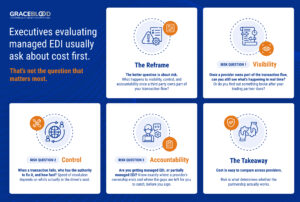
Outsourcing EDI management should reduce the burden on internal employees. It should not mean losing visibility into critical business transactions. Some managed platforms effectively operate as black boxes. Transactions enter the system and outputs emerge, but internal teams have limited ability to see what happened between those points.
That becomes a serious problem when something fails.
Poor error handling can allow exceptions to remain unresolved until a customer complains, an invoice goes unpaid, or a chargeback appears. Extended downtime during a high-volume order period can have an even larger impact.
How to Mitigate the Risk
Visibility and support should be core evaluation criteria for any managed EDI service. Ask prospective providers what users can see in real time, how exceptions are identified, how alerts are delivered, and who is responsible for investigating problems.
Also review support SLAs. Determine how the EDI provider responds when a critical transaction fails and whether support includes actual EDI expertise or simply access to a general help desk.
VelociLink™ Analytics provides real-time visibility across the order lifecycle while automated validation helps identify discrepancies before they create larger problems. GraceBlood reports that its analytics capabilities can reduce revenue leakage by up to 30% and cut research time by as much as 50%.
That visibility is particularly important with a managed EDI service model. Outsourcing day-to-day administration should give internal teams greater control over business outcomes—not less information about what is happening.
Other EDI Delivery Models Executives Should Understand
A fully managed model is not the only option available.
On-premise EDI solutions give organizations direct control over infrastructure and EDI management but generally require greater in-house expertise, maintenance, upgrades, monitoring, and security responsibility.
Web EDI can provide a simpler way for smaller organizations or low-volume partners to exchange transactions through an online portal. Web EDI may be useful when full ERP integration is unnecessary, although it requires more manual interaction than an integrated environment.
Cloud-based EDI solutions move infrastructure and software management outside the client’s environment and can make scalability and remote administration easier.
A fully managed EDI solution goes further by transferring much of the operational responsibility to the provider, including monitoring, partner onboarding, mapping, compliance changes, troubleshooting, and ongoing support.
There is no universal delivery model that fits every organization. The important question is how much responsibility your business wants to retain and whether you have the in-house expertise to manage it effectively.
How GraceBlood Mitigates Managed EDI Risk
Choosing an EDI service provider is ultimately about reducing operational uncertainty. GraceBlood’s VelociLink™ Managed Services is designed around that objective.
The GADGET™ implementation methodology creates a structured process from initial requirements through post-go-live optimization. GraceBlood’s ERP experience helps address integration challenges across both modern and complex environments, while its managed approach reduces the need for organizations to maintain specialized EDI expertise internally.
VelociLink™ also supports the scalability required as transaction volumes and trading partner networks grow. Real-time visibility and exception management give clients insight into transactions without requiring them to manage the underlying platform themselves.
GraceBlood’s annual SOC 1 audit, flexible contracting approach, and combination of EDI and integration expertise further address several of the risks executives should consider during provider selection.
Rather than evaluating an EDI solution solely on whether it can transmit documents, executives should evaluate the complete operating model: implementation, integration, security, scalability, support, visibility, and the expertise of the people responsible for keeping the environment running.
For ERP Resellers
These considerations are equally important for ERP resellers.
When EDI is treated as an afterthought, problems can surface during or after ERP go-live and reflect poorly on the entire implementation—even when the underlying issue is outside the ERP itself.
GraceBlood’s VelociNetwork™ Referral Partner Program gives ERP resellers access to a specialized EDI partner that can manage the EDI portion of the project without competing for the ERP relationship. That allows ERP teams to remain focused on their core implementation while GraceBlood handles trading partner requirements, data mapping, connectivity, testing, and ongoing EDI operations.
The result is a cleaner division of responsibility and less risk that EDI complications will derail an otherwise successful ERP project.
Get Started with the Right EDI Solution for Your Business Today.
Heading to Microsoft Community Summit or SuiteWorld next month? So are we! Would love to meet you & hear about your company. Book a time here.
Frequently Asked Questions About Managed EDI Solutions
What risks should executives consider when adopting managed EDI solutions?
Executives should evaluate six primary risk categories when adopting managed EDI solutions: implementation risk (underestimating complexity and timeline), integration risk (EDI that fails to connect seamlessly with existing ERP systems), security and compliance risk (data breaches and regulatory exposure from inadequate encryption or access controls), vendor lock-in risk (long-term contracts or proprietary formats that make switching costly), scalability risk (providers that become bottlenecks as transaction volume grows), and support and visibility risk (no real-time monitoring or exception alerting). Each risk can be mitigated through careful provider evaluation, documented implementation methodology, pre-built ERP connectors, and platforms with real-time visibility built in.
What challenges might a company face when implementing EDI?
Common EDI implementation challenges include: mapping complexity when each trading partner has unique data requirements and non-standard implementations; ERP integration gaps when EDI data fails to flow automatically into internal systems; rushed testing phases that miss edge cases and trigger chargebacks from day one; resource constraints when internal teams lack EDI expertise; and compliance management as trading partner requirements evolve over time. Managed EDI providers with structured implementation methodologies and pre-built trading partner connections significantly reduce the frequency and severity of these challenges.
What is included in an EDI managed service?
A comprehensive EDI managed service typically includes: EDI setup and configuration for all required trading partners; trading partner mapping and data mapping for each transaction set; ongoing compliance monitoring and automatic updates as partner requirements change; transaction processing and error handling; real-time monitoring and exception alerting; ERP integration through pre-built connectors or custom development; trading partner onboarding for new partnerships; and support and troubleshooting. GraceBlood’s VelociLink™ Managed Services cover all of these areas under a single managed platform.
How much does EDI implementation cost?
EDI implementation costs vary significantly based on the number of trading partners, transaction volume, ERP complexity, and whether you choose self-managed, partially managed, or fully managed EDI services. Fully managed EDI solutions like VelociLink™ typically offer predictable monthly pricing based on service tier and transaction volume, eliminating the unpredictable costs of in-house EDI infrastructure, staffing, and maintenance. The most important cost comparison is total cost of ownership: managed EDI often delivers lower TCO than in-house alternatives when staff costs, compliance management, and infrastructure are factored in.
Do I need to be EDI compliant to do business with trading partners?
For most mid-sized manufacturers and distributors working with major retailers and distributors, yes. Major retailers like Walmart, Target, and Amazon require EDI compliance as a non-negotiable condition of doing business. EDI requirements typically include support for specific transaction sets (EDI 850 Purchase Order, EDI 856 Advance Ship Notice, EDI 810 Invoice) in standardized formats like ANSI X12. Failure to meet these requirements results in chargebacks, compliance penalties, and in some cases, loss of the trading partner relationship entirely.
Selecting the right EDI solution is therefore about much more than technology. The right provider should help your organization connect reliably, adapt as requirements change, and support growth without forcing your internal team to become EDI experts.