
The successful onboarding of new vendors should be the beginning of a productive business relationship. Too often, however, it becomes a lengthy technical project involving spreadsheets, email chains, connectivity issues, testing delays, and repeated troubleshooting.
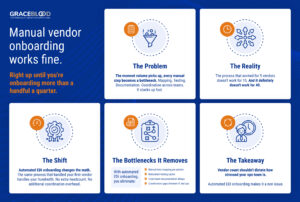
For procurement and IT teams, traditional vendor onboarding can consume significant resources. Every new vendor may introduce different technical capabilities, document formats, business rules, and EDI requirements. When teams manage those differences manually, adding new trading partners can quickly create an onboarding backlog.
Electronic data interchange automation changes that equation. By standardizing connectivity, automating validation, and creating repeatable workflows, EDI onboarding can become faster and more predictable. Instead of reinventing the process for every new vendor, organizations can establish an onboarding framework that scales as their supplier network grows.
For ERP resellers, this is also an important post-implementation consideration. A successful ERP project does not end when the software goes live. Clients still need an efficient way to connect suppliers and customers to that system.
This guide explains how EDI automation streamlines vendor onboarding, which transactions matter most, and how businesses can build a faster, more scalable onboarding process.
Table of Contents
- Why Vendor Onboarding Is Slow Without EDI Automation
- Define the Business Relationship Before EDI Onboarding Begins
- How EDI Automation Accelerates Vendor Onboarding
- Key EDI Transaction Sets That Drive Vendor Onboarding
- Best Practices for EDI Vendor Onboarding
- What Faster Vendor Onboarding Delivers
- How VelociLink™ Simplifies Vendor Onboarding
Why Vendor Onboarding Is Slow Without EDI Automation
A new vendor connection may sound simple: establish connectivity, exchange a few EDI documents, test them, and go live. In reality, traditional EDI onboarding involves numerous technical and operational steps.
Manual Onboarding Bottlenecks
Before a vendor can begin exchanging production transactions, teams need to determine what the vendor supports, how EDI data will be transmitted, and how information should flow into internal systems. That can involve establishing communication protocols, reviewing implementation guides, configuring data mapping, testing files, validating required fields, and resolving exceptions. If the vendor uses a different standard or has unique business rules, additional configuration may be necessary.
The burden grows when these activities are handled manually for every partner. IT teams may find themselves creating one-off connections rather than using a consistent supplier onboarding process. Testing can become another bottleneck. A missing field, incorrect qualifier, formatting error, or failed connection may lead to multiple rounds of emails and file exchanges. Each correction adds time to the process. Meanwhile, procurement teams are waiting for the relationship to become operational.
Manual processes also make it more difficult to ensure data accuracy and EDI compliance before launch. Requirements for invoices, acknowledgments, labels, or ship notices may differ among retailers and other partners. Discovering those differences after production begins can result in rejected transactions, delayed payments, or chargebacks.
The Business Cost of Slow Vendor Onboarding
The consequences extend beyond IT. When vendor onboarding takes weeks or months, the organization may be unable to realize the full value of a new supplier relationship. Orders can be delayed, employees may resort to manual data entry, and teams spend valuable time managing workarounds.
The problem becomes especially significant as the organization grows. If every new vendor requires roughly the same amount of manual effort, onboarding cannot scale efficiently. Adding more suppliers simply creates more work. That can also affect supplier relationship management. A difficult onboarding experience creates frustration before the relationship has had an opportunity to succeed.
EDI automation provides an alternative: create a standardized process that can be repeated across the trading partner network rather than rebuilding the workflow every time.
Define the Business Relationship Before EDI Onboarding Begins
Before EDI onboarding can begin, the two companies first need to define the business rules that EDI will ultimately automate. EDI can move information between systems quickly and accurately, but it cannot determine the commercial terms of a new supplier relationship.
For every new vendor, procurement, operations, finance, and other stakeholders may need to establish details such as:
- Which SKUs or product categories are approved for purchase
- Item numbers, UPCs, GTINs, and other product identifiers
- Case quantities, pack sizes, units of measure, and minimum order quantities
- Contracted pricing, discounts, allowances, and effective dates
- Approved warehouses, stores, distribution centers, or other shipping destinations
- Shipping methods, carriers, freight terms, and responsibility for shipping charges
- Lead times, delivery windows, and fulfillment expectations
- Payment terms and invoicing requirements
- Returns, substitutions, backorders, and cancellation policies
- Labeling, packaging, and other fulfillment requirements
These decisions may exist in contracts, pricing files, item masters, routing guides, or internal ERP records. They are not EDI decisions, but they directly determine how the eventual EDI workflow needs to operate.
For example, an EDI 850 Purchase Order may technically be formatted perfectly, but the transaction can still create a business problem if it contains an unauthorized SKU, incorrect pack size, outdated price, or invalid ship-to location. Similarly, an EDI 810 Invoice can pass technical validation while containing freight charges that do not match the terms negotiated between the buyer and vendor.
That is why effective vendor onboarding should distinguish between business onboarding and EDI onboarding. First, the organizations agree on what they will buy and sell and under what conditions. Then the EDI team translates those agreed-upon rules into automated transaction flows, mappings, validations, and system integrations.
Establishing this information upfront gives the EDI team a clean foundation for data mapping and testing. It also helps prevent a common onboarding problem: treating every failed transaction as an EDI issue when the real problem is an unresolved or incorrectly configured business rule. The better these requirements are defined before technical onboarding begins, the easier it is to build an automated relationship that works correctly from the first production transaction.
How EDI Automation Accelerates Vendor Onboarding
Automation addresses many of the activities that traditionally consume the most time during EDI onboarding. The goal is not simply to move files faster. It is to reduce unnecessary manual intervention throughout the setup, testing, validation, and go-live process.
Reusable Trading Partner Connections
One of the biggest opportunities for improving vendor onboarding is eliminating unnecessary development work. Rather than starting every connection from scratch, an experienced EDI provider can leverage existing knowledge, established integrations, standardized processes, and reusable components to accelerate onboarding. Common EDI standards, such as ANSI X12 and EDIFACT, also provide a consistent framework for exchanging business information.
This does not mean every partner is identical. Trading partners can still have unique implementation guides, qualifiers, business rules, and document requirements. The advantage is that teams do not need to reinvent the entire connection simply because one requirement differs. A well-designed EDI platform provides a foundation that can accommodate those differences while maintaining standardized processes behind the scenes.
Automated Testing and Validation
Testing is one of the most important parts of EDI onboarding, but it can also be one of the most time-consuming when handled manually. Automated EDI validation can identify formatting problems, missing fields, invalid values, and other issues before a transaction reaches the ERP system or external partner. Problems can then be corrected before production traffic begins.
This creates an important quality checkpoint. Rather than waiting for a vendor or customer to reject a transaction, the system can identify exceptions earlier in the process. GraceBlood’s VelociLink™ Managed EDI provides real-time monitoring and validation to help organizations identify issues quickly and maintain reliable transaction flows during onboarding and beyond.
Faster, Standardized Connectivity
Vendors do not all have the same technical resources. One supplier might communicate through AS2, another through SFTP, and another through a VAN. Some smaller suppliers may not have traditional EDI infrastructure at all.
A managed approach allows businesses to accommodate different communication protocols without forcing internal IT teams to build and maintain every connection themselves. Managed file transfer capabilities can also provide secure, controlled movement of business data between systems and partners. For suppliers without traditional EDI capabilities, web EDI can provide another option. A browser-based web portal allows smaller vendors to receive and respond to business documents without implementing a complete EDI environment.
The result is greater flexibility: the buyer can maintain a standardized onboarding strategy even when its suppliers have very different technical capabilities. GraceBlood’s GADGET™ methodology further accelerates the process, delivering 50% faster implementation than traditional providers. That structured methodology helps businesses move from discovery through testing and deployment efficiently rather than treating each new connection as an isolated IT project.
Key EDI Transaction Sets That Drive Vendor Onboarding
Successful EDI onboarding is ultimately about making sure the documents that power the business relationship work correctly from day one.
For many organizations, four ANSI X12 transaction sets form the foundation.
The Core Documents That Must Work From Day One
EDI 850 – Purchase Order
The EDI 850 communicates order information from buyer to supplier. It can include products, quantities, pricing, shipping information, and other details required to fulfill an order.
Because purchase orders often initiate the transaction cycle, inaccurate information at this stage can affect everything downstream.
EDI 855 – Purchase Order Acknowledgment
The EDI 855 allows the vendor to acknowledge the order and communicate whether it has been accepted, rejected, or modified.
Automating acknowledgments gives buyers faster visibility into whether suppliers can fulfill their purchase orders, reducing the need for phone calls and emails.
EDI 856 – Advance Shipping Notice
The EDI 856 communicates shipment details before goods arrive. Depending on the relationship, it may contain information about cartons, pallets, products, quantities, carriers, and tracking.
Accurate advance ship notices are especially important when warehouses rely on incoming shipment information to plan receiving activities in a WMS.
EDI 810 – Invoice
The EDI 810 transmits invoice information electronically. When integrated correctly, e-invoicing can help automate the flow of billing data while reducing manual handling.
An effective EDI integration can also support matching invoice information against purchase order and shipment data, helping identify discrepancies before they create payment problems.
Why Getting These Transactions Right Matters
Errors that make it into production can have immediate consequences. Incorrect quantities, missing identifiers, invalid shipment information, or improperly formatted invoices can result in transaction rejection, payment delays, operational disruption, and compliance penalties.
Automated testing during vendor onboarding allows teams to validate these workflows before the first production transaction. It is much easier to resolve an incorrect field during testing than after a shipment has already left the warehouse. Getting the core documents right also establishes a stronger foundation for future EDI transactions and additional automation.
Best Practices for EDI Vendor Onboarding
Automation is powerful, but technology alone does not guarantee efficient onboarding. The best results come from combining automation with a disciplined, repeatable process.
1. Start With a Thorough Discovery Process
Before configuring anything, understand the vendor. Document its technical capabilities, required documents, supported EDI standards, connectivity options, business rules, and testing expectations. Determine whether the vendor already exchanges EDI or needs an alternative such as web EDI.
Discovery should also identify how information will interact with internal systems. For example, does transaction data need to flow into NetSuite, another ERP, a warehouse application, or multiple systems? This is also the time to identify unusual segments, custom qualifiers, routing rules, and regulatory requirements.
Finding these requirements before development begins reduces surprises later.
2. Standardize the Onboarding Process
Organizations should avoid treating every vendor as an entirely new project. Create a standard workflow for discovery, configuration, EDI mapping, testing, approval, deployment, and post-launch monitoring. Standardization improves consistency while giving teams clear checkpoints for determining when a vendor is ready for production.
Templates and documented testing procedures can further accelerate the process. Standardization is especially valuable for risk management because it reduces the likelihood that important testing or compliance steps will be overlooked under pressure to meet a launch date.
3. Run a Pilot Before Full Launch
Even highly automated workflows should be tested before full transaction volume begins. Use realistic data and the same connectivity that will be used in production. Test transactions end to end rather than confirming only that a file can be transmitted successfully.
An 850, for example, should not simply arrive at the destination. Teams should confirm that the information is interpreted correctly and reaches the appropriate application. The same principle applies to EDI invoicing. An invoice that passes basic syntax testing may still create problems if fields do not align correctly with the receiving system.
A controlled pilot provides an opportunity to identify those problems before they affect live business.
4. Partner With EDI Specialists
Maintaining an internal EDI operation requires more than purchasing EDI software. Organizations need expertise in mapping, connectivity, partner specifications, troubleshooting, monitoring, and ongoing changes. For mid-sized organizations without dedicated EDI teams, managed EDI services can remove much of that burden.
Instead of internal teams managing every aspect of the onboarding workflow, EDI specialists can handle technical configuration, testing, monitoring, and ongoing support. GraceBlood’s GADGET™ methodology provides a structured approach to implementation and onboarding. In fact, 91% of GraceBlood clients credit GADGET™ as fundamental to their project success.
For organizations evaluating fully managed EDI solutions, the distinction is important: the value comes not only from the technology but also from having experienced specialists responsible for keeping connections working.
What Faster Vendor Onboarding Delivers
Reducing onboarding time creates benefits across procurement, IT, operations, finance, and the broader supply chain.
Operational Benefits
First, faster EDI onboarding reduces the workload associated with each new connection. IT teams spend less time on repetitive integration work and troubleshooting. Procurement gains a more predictable timeline for activating new suppliers. Operations receives cleaner, more consistent information. Automation also reduces dependence on manual data entry, which helps improve accuracy while allowing employees to focus on exceptions and higher-value activities.
A repeatable process makes scaling easier as well. Instead of adding administrative effort every time the supplier base grows, the organization can rely on established workflows and automation. That scalability becomes increasingly valuable as B2B integration expands across more partners, transaction types, applications, and business units.
Business Benefits
Faster onboarding can shorten the time between signing a new vendor and actually doing business with that vendor. It can also improve the early stages of the relationship. When transactions work correctly from day one, trading partners spend less time troubleshooting and more time fulfilling orders. Better automation can support broader supply chain management goals as well. Faster access to suppliers gives businesses more flexibility to respond to demand changes, sourcing needs, and growth opportunities.
An effective onboarding framework also strengthens risk management by establishing consistent testing and validation before new connections enter production. For ERP resellers, these outcomes provide a tangible way to demonstrate value after implementation. Helping clients connect their external business network to the new ERP environment transforms the ERP from an internal application into part of a broader automated ecosystem.
How VelociLink™ Simplifies Vendor Onboarding
GraceBlood’s VelociLink™ Managed Services combines technology, EDI expertise, and ongoing support to simplify the onboarding and management of trading partners.
Built-In Onboarding Capabilities
VelociLink™ provides the infrastructure and expertise required to connect organizations with partners using different standards, document requirements, and technical capabilities. Instead of asking internal teams to manage the entire EDI implementation, GraceBlood works through the discovery, configuration, testing, deployment, and support process.
The GADGET™ methodology provides a structured implementation framework and delivers 50% faster implementation than traditional providers.
Once connections are established, real-time monitoring helps identify transaction issues and exceptions quickly. That visibility is important because onboarding does not truly end the moment a partner goes live. New connections need to perform reliably under real-world transaction volumes.
Ongoing Onboarding Support
A scalable onboarding strategy must also account for what happens next. Trading partner specifications change. New transaction sets are added. Business rules evolve. Vendors may change systems or connectivity methods.
VelociLink™ Managed Services provides ongoing monitoring and support so internal teams do not have to manage every technical change themselves. VelociLink™ Analytics adds visibility into transaction health and exceptions, helping teams identify problems before they escalate.
GraceBlood processes more than $1 billion in transactions annually, providing the infrastructure required to support trading partners at scale. For vendors without traditional EDI capabilities, web EDI can also provide a practical path to participation while maintaining an electronic workflow.
For ERP resellers, GraceBlood’s VelociNetwork™ program provides access to EDI and B2B integration expertise without requiring resellers to build that expertise internally. Clients receive specialized support while the reseller can remain focused on the ERP implementation and relationship.
Ready to Streamline Your Vendor Onboarding?
Vendor onboarding does not have to become a new IT project every time a supplier is added. With automation, standardized workflows, secure connectivity, systematic testing, and ongoing monitoring, organizations can turn onboarding into a repeatable process that supports growth rather than slowing it down.
For operations and procurement teams, GraceBlood’s VelociLink™ Managed Services and GADGET™ methodology provide a way to accelerate onboarding while reducing the technical burden on internal resources.
For ERP resellers, the VelociNetwork™ program makes it possible to bring specialized EDI expertise into client projects without taking on the complexity yourself.
Ready to make your next vendor connection easier? Schedule a consultation with GraceBlood to learn how VelociLink™ can streamline onboarding from initial discovery through live transactions.
EDI Vendor Onboarding: Frequently Asked Questions
What Is the EDI Onboarding Process?
EDI onboarding is the process of preparing a new trading partner to exchange electronic business documents with your organization. It typically includes assessing technical capabilities, selecting connectivity, configuring maps, testing transactions, validating business rules, and approving the connection for production. A well-designed onboarding process also determines how incoming and outgoing information will interact with internal applications so data can move automatically rather than requiring employees to rekey it.
What Is EDI Trading Partner Setup?
Trading partner setup is the technical and operational configuration required to exchange electronic documents between two businesses. It can include selecting protocols such as AS2, SFTP, or a VAN; configuring maps; establishing business rules; testing document flows; and confirming that each transaction is processed correctly by both organizations. Because different trading partners may have unique specifications, a standardized setup methodology helps organizations accommodate those differences without creating an entirely new process for every connection.
How Long Does EDI Onboarding Take?
Timelines depend on the complexity of the partner, number of documents, systems involved, testing requirements, and availability of both organizations. Traditional approaches can take weeks or even months when integrations, testing, and troubleshooting are managed manually. A managed EDI platform with established processes, reusable components, and dedicated specialists can significantly shorten the timeline. GraceBlood’s GADGET™ methodology delivers 50% faster implementation than traditional providers, helping organizations move more efficiently from initial discovery to production.
How Can EDI Automation Streamline the Vendor Onboarding Process?
EDI automation replaces many repetitive onboarding activities with standardized, automated workflows. Instead of relying heavily on spreadsheets, emails, and manual file checks, organizations can automate validation, connectivity, transaction processing, and exception monitoring. This reduces back-and-forth troubleshooting while giving teams a repeatable framework for adding new vendors. Automation also makes the supplier onboarding process more scalable because adding another vendor does not necessarily require adding a proportional amount of internal work.
How Do You Improve the Vendor Onboarding Process?
Start by standardizing discovery, documentation, testing, and approval procedures. Identify each vendor’s technical and business requirements before configuration begins, test realistic transactions end to end, and automate validation wherever possible. Organizations should also evaluate where specialist support could eliminate internal bottlenecks. A managed provider can take responsibility for technical onboarding and ongoing maintenance while procurement and IT focus on the vendor relationship and broader business priorities. The objective is not merely faster setup. Effective vendor onboarding creates reliable connections that continue performing after go-live—and provides a scalable foundation for adding future suppliers without rebuilding the process every time.